

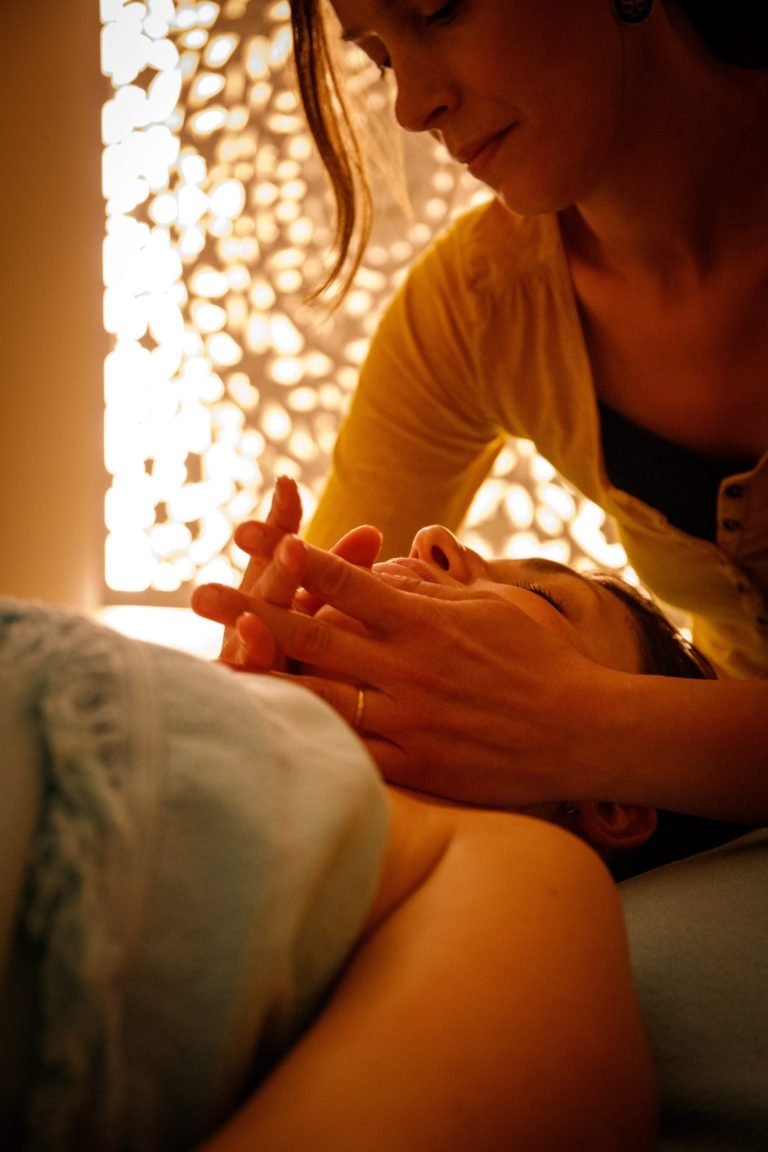
Yoga nidra is a guided relaxation practised lying down with your eyes closed, simply following a voice. It is also known as ‘yogic sleep’: the body rests deeply, but the mind stays just awake enough to follow the session. You don’t need to be flexible, or to have done any yoga before.
In this guide, we explain where the practice comes from, how a session unfolds step by step, what you can reasonably expect from it, and how to try it during a stay by the Gulf of Morbihan.
Yoga nidra: what exactly is it?
A waking ‘yogic sleep’
Nidra means ‘sleep’ in Sanskrit. Yet the aim is not to fall asleep: it is to drift into an in-between state, between waking and sleep, in which the body lets go completely while your attention remains present.
In practice, you lie still and a voice guides you from start to finish. There is nothing to achieve: you simply listen and follow the instructions as best you can. If you drift off along the way, it doesn’t matter; it often happens in the first few sessions.
Where does the practice come from?
Yoga nidra as it is practised today was developed in the 1960s by Swami Satyananda Saraswati, founder of the Bihar School of Yoga in India. He drew on much older relaxation and concentration techniques from the yoga traditions.
Since then the method has spread worldwide, often simplified and adapted. You will find it in yoga classes, both in studios and online, and in some wellness centres.
What happens in a yoga nidra session?
A session usually lasts between twenty minutes and an hour. The sequence varies from one teacher to another, but almost always follows the same main stages.
Getting comfortable
You lie on your back on a mat, arms by your sides, palms facing up: this is yoga’s relaxation pose, known as savasana. A cushion under your head or knees, a blanket over you: your body temperature drops as you relax, so it is best not to get cold.
Setting an intention, the sankalpa
At the start of the session, the teacher invites you to form a short positive phrase, in the present tense, that feels like you: the sankalpa. ‘I am calm’, ‘I take my time’… You repeat it silently at the beginning and end of the practice.
Travelling through the body
Next comes the heart of the session: the voice guides you around the body, part by part, from the hands to the feet. All you need to do is bring your attention to each area as it is named, without moving. This is known as the rotation of consciousness.
Depending on the teacher, this may be followed by observing the breath, opposite sensations (heaviness and lightness, warmth and cold) or short visualisations: a beach, a sky, a simple image.
Coming back gently
The session ends by gradually bringing your attention back to the room, the sounds, the feel of the floor. You move your fingers, stretch and roll onto your side before getting up. There is no hurry: many people describe this return as the most pleasant moment.
What are the benefits of yoga nidra?
The first and most immediate benefit is deep relaxation. People describe feeling heavier in the body, breathing more slowly and having a calmer mind by the end of the session. A simple pause to release built-up tension.
Many also use it to switch off at the end of the day, or to recover after exertion: a long walk, a day in the fresh air, a journey. By calming the mind, yoga nidra often makes it easier to fall asleep.
The myth: ‘one hour of yoga nidra is worth four hours of sleep’
The claim is widely repeated, and it is an appealing one. But there is nothing scientific about it: yoga nidra rests and soothes, it does not replace a night’s sleep. It is better seen as a complement than a shortcut.
Finally, yoga nidra is not a medical treatment. If you suffer from persistent sleep problems or anxiety, talk to your doctor: the practice can support medical care, not replace it.
Yoga nidra: who is it for?
It is probably the gentlest way into yoga. There are no difficult poses and no physical effort: all you need is to be able to lie down for half an hour. Beginners, sporty types, people with limited mobility: anyone can practise it.
A few precautions
The practice is very accessible, but it does invite introspection. If you are psychologically vulnerable, have experienced recent trauma or have a mental health condition, ask your doctor’s advice and let the teacher know before you start. During the session you can always open your eyes, move or stop: you remain in control.
Your first session
- Avoid a heavy meal just beforehand: digestion gets in the way of relaxation.
- Wear loose clothing and keep a warm layer within reach.
- Don’t try to ‘get it right’: letting yourself be guided is enough.
- If you fall asleep, it isn’t a failure: your attention will settle as the sessions go by.
Yoga nidra, meditation, a nap: what’s the difference?
Meditation is usually practised sitting up, and asks you to direct your own attention: to the breath, a sensation, a word. Yoga nidra, on the other hand, is practised lying down and is entirely guided: you just follow the voice.
A nap, finally, is real sleep: you lose awareness and control nothing. Yoga nidra, by contrast, seeks to stay on the threshold, relaxed but aware. That is what makes it so distinctive: you rest without drifting away.
Practising yoga nidra at Le Parc Fétan
Yoga nidra is one of the practices offered in the hotel’s wellness area, alongside massages, cryotherapy and the heated pool. A simple way to make the calm of a day spent outdoors, on the coastal path or by the water, last a little longer.
To find out about session times and book, the easiest way is to ask at reception or write to us to book a session. And if you like to practise outdoors, the Gulf lends itself to that too: discover our ideas for yoga by the sea and walks from the hotel.
Lying down, guided, effortless: yoga nidra can be discovered at any age, in a single session. The best way to find out what it does for you is to try it, somewhere quiet, away from your routine. Why not during a stay in one of our rooms overlooking the Gulf or the garden?
Written by the Le Parc Fétan team
From Larmor-Baden, looking out over the Gulf.

