
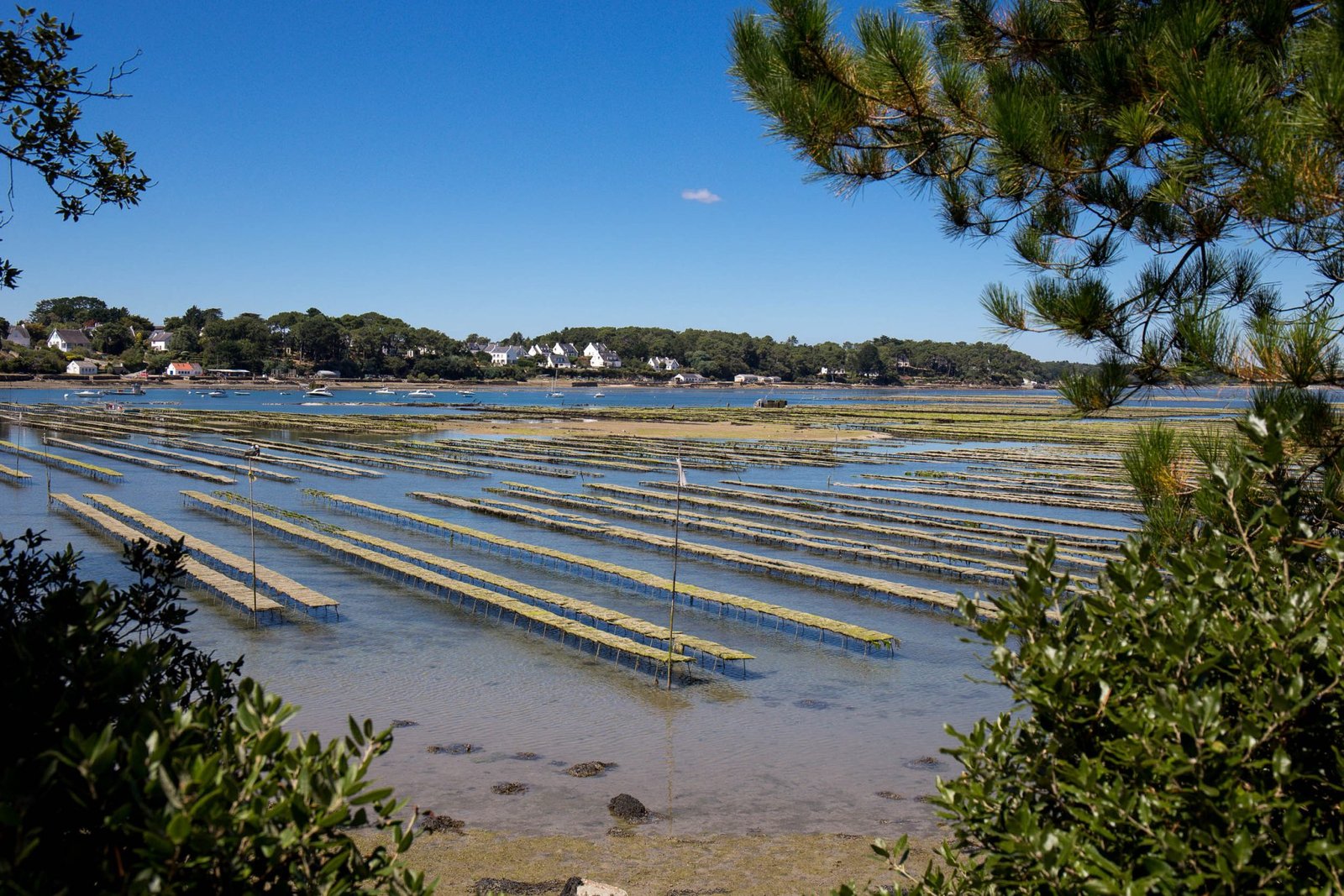
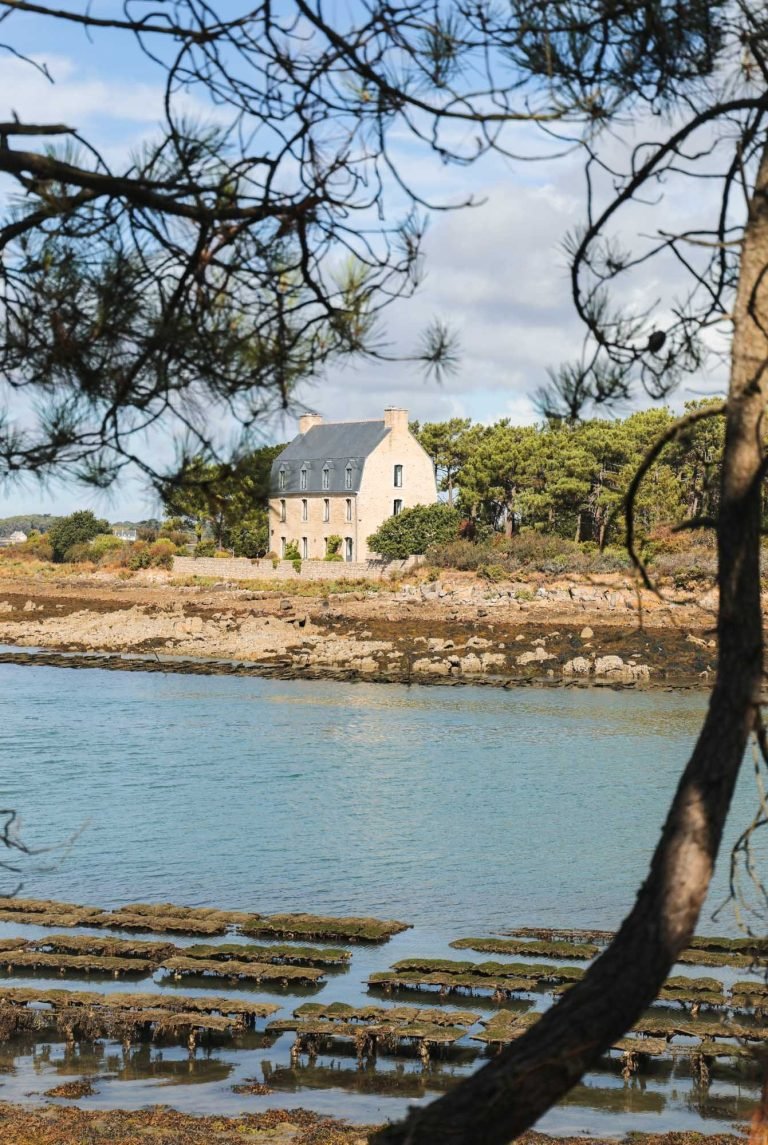
Gulf of Morbihan oysters owe their flavour to a unique inland sea, stirred twice a day by the tides. Most of those farmed here are rock oysters, and a few producers still grow the flat oyster, the historic variety of the Breton coast. To enjoy them at their best, nothing beats a tasting near the oyster beds, or a dozen served at dinner.
Here is how to tell them apart, read a label, choose the right season and find out where to taste them.
Why Gulf of Morbihan oysters are so highly regarded
A small sea stirred by the tides
The Gulf of Morbihan is a small inland sea, dotted with around forty islands and linked to the ocean by a narrow channel. With every tide, a huge volume of water flows in and out, constantly renewing the waters in which the oysters grow.
This mixing, combined with fresh water from the rivers, feeds the plankton on which the shellfish live. Each area has its own character: oyster farmers like to talk of ‘merroir’, much as wine-makers talk of terroir.

The Auray river, oyster-farming country
In the west of the Gulf, the Auray river and its banks are among the historic oyster-farming areas of the Morbihan. Oyster sheds, beds and trestles shape the landscape, to the rhythm of the tides.
Rock oyster or flat oyster: how to tell them apart
The rock oyster is by far the most common. Its shell is elongated and irregular, rounded underneath. Its flesh is plump and briny, sometimes slightly sweet depending on where it grew. It became established on the French coast in the early 1970s, after a disease wiped out the species that had been farmed until then.
The flat oyster is the native variety of the Breton coast. Its shell is round and flat, its flavour more delicate, with a hint of hazelnut often mentioned. More fragile and rarer, it is also more expensive. In the Gulf, a few producers still farm it.
Sizes, fines and spéciales: reading a label
On the counter, rock oysters carry a size number, from no. 0 for the largest to no. 5 for the smallest. The number corresponds to the oyster’s weight:
- no. 0: over 150 g;
- no. 1: 111 to 150 g;
- no. 2: 86 to 110 g;
- no. 3: 66 to 85 g, one of the most common sizes;
- no. 4: 46 to 65 g;
- no. 5: 30 to 45 g.
The terms ‘fine’ and ‘spéciale’, on the other hand, indicate the amount of flesh in relation to the total weight: a spéciale is meatier than a fine. It is a matter of taste rather than quality. Flat oysters, finally, have their own size scale.
What is the best season for oysters?
You often hear that oysters should only be eaten in months with an ‘r’ in them, from September to April. It is an old custom, dating from a time when there was no way of keeping shellfish cool through the summer. Today, thanks to refrigeration and health controls, you can eat them all year round.
Summer is still a season apart, though. It is the spawning period, and oysters often become ‘milky’: their flesh, creamier and softer, is not to everyone’s taste, but it is perfectly safe. From autumn to spring, the flesh becomes firmer and brinier again. This is the season oyster lovers prefer, peaking around Christmas and New Year.
Where to taste oysters in the Gulf of Morbihan
The best way is to taste them by the water, at the producers’. Many of the Gulf’s oyster farmers open a hut or an oyster bar near their beds, often in the warmer months. You can enjoy a dozen with bread and butter, looking out over the oyster trestles.
The tourist office keeps an up-to-date list of producers who offer tastings. Remember to check opening days before you go, as they often change with the season.
Opening an oyster properly
- Hold the oyster flat in a folded tea towel, rounded side down, so it keeps its water.
- Slide the blade of the oyster knife between the two shells, at the side, to cut through the muscle, then lift off the top shell.
- Pour away the first water: the oyster will produce fresh, tastier water within a few minutes.
- A fresh oyster is alive: it should be tightly closed, or close up when touched.
What to serve with oysters
Purists eat them plain, simply opened, to keep all their briny flavour. Others add a few drops of lemon, or a shallot and vinegar sauce, the famous mignonette. A slice of buttered rye bread often completes the platter.
As for the glass, choose a dry, crisp, mineral white wine. Muscadet, produced close to Brittany around Nantes, is a great classic, as is Gros Plant. A Chablis or a Picpoul de Pinet also make excellent pairings.
Keeping your oysters fresh
Bought from the producer, oysters will keep for a few days somewhere cool, at roughly 5 to 15 °C, lying flat and covered with a damp cloth. Avoid the freezer, and never put them in fresh water: they would not survive.
Oysters at dinner at Le Parc Fétan
At the hotel, the restaurant serves a single set menu in the evening, different every day and put together with local producers. The oysters come from the Mahé brothers, oyster farmers in Larmor-Baden: every evening the restaurant is open, you can order them in addition to the menu.
That is what short supply chains are about too: less transport, fresher produce and cooking that follows what the sea and the land provide. Discover the producers behind our menu and our approach to sustainable tourism.
Rock or flat, fines or spéciales, Gulf of Morbihan oysters are best discovered through the seasons, as close to the beds as possible. To taste them without even taking the car, book a table at our restaurant: dinner is served from 7pm to 9pm, and non-residents are welcome.
Written by the Le Parc Fétan team
From Larmor-Baden, looking out over the Gulf.

